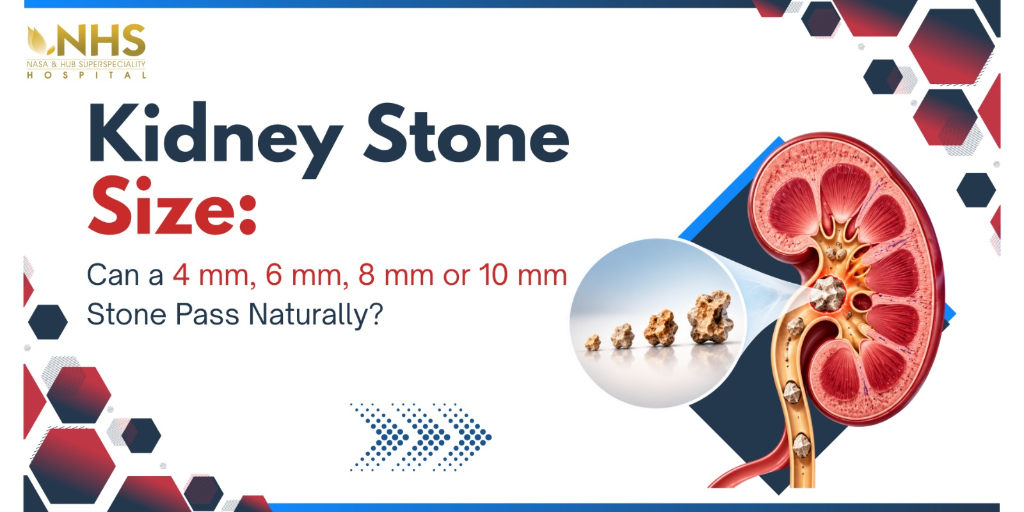
Kidney Stone Size: Can a 4 mm, 6 mm, 8 mm or 10 mm Stone Pass Naturally?
Understanding Stone Size, Urinary Tract Passage, Location Factors and Advanced Urology Care
Quick AI Summary
- Size vs. Passage Likelihood: Stones up to 4 mm have the highest chance of passing naturally under medical guidance. A 6 mm stone is less predictable, while 8 mm and 10 mm stones are far less likely to pass spontaneously and often require intervention.
- Location & Obstruction Matter: Size alone is not the sole factor. Stone position (kidney, upper ureter vs. lower ureter), presence of urinary blockage, kidney swelling (hydronephrosis), and infection dictate whether observation is safe.
- Advanced Urological Solutions: At NHS Hospital Jalandhar, the Department of Urology offers modern diagnostic evaluation (NCCT KUB) and minimally invasive treatments, including Holmium Laser Lithotripsy, URS, RIRS, and PCNL.
A kidney stone measuring 4 mm may sound tiny — until it starts moving.
The pain can be sudden, intense and difficult to ignore. Once an ultrasound or CT scan confirms a kidney stone, one of the first questions patients ask is:
Will this kidney stone pass naturally, or will I need treatment?
The answer depends on more than just the size of the stone.
A smaller stone generally has a better chance of passing naturally through the urinary tract, but its location, shape, associated blockage, symptoms and the patient's overall health also matter.
A 4 mm stone and a 10 mm stone therefore cannot be approached in the same way.
At the Department of Urology, NHS Hospital, Jalandhar, patients with kidney stones are evaluated to determine whether observation is appropriate or whether medical or procedural treatment is required.
Here is what different kidney stone sizes can mean.
Why Does Kidney Stone Size Matter?
Kidney stones form when certain minerals and salts in the urine crystallise and gradually develop into hard deposits.
Some stones remain inside the kidney without causing significant symptoms. Others move into the ureter — the narrow tube carrying urine from the kidney to the bladder. This is often when severe pain begins.
The size of a stone is usually reported in millimetres (mm) on ultrasound, CT or other imaging. In general, smaller stones are more likely to pass through the urinary tract without a procedure. As stone size increases, spontaneous passage becomes less likely.
However, size alone should never determine treatment. A urologist will also consider:
- Where the stone is located
- Whether urine flow is obstructed
- Whether the kidney is swollen (hydronephrosis)
- Severity and frequency of pain
- Presence of infection
- Kidney function (creatinine / eGFR)
- Number and shape of stones
- Previous history of kidney stones
- Patient's age and overall health
This is why two people with the same-sized stone may receive completely different treatment recommendations.
Can a 4 mm Kidney Stone Pass Naturally?
A 4 mm kidney stone is relatively small and may pass naturally in many patients, particularly when it has entered the ureter and there are no complications.
A urologist may recommend observation along with appropriate medical management when the patient is clinically stable. This may include advice regarding hydration, pain management and, in selected cases, medication (Medical Expulsive Therapy) to help facilitate stone passage.
However, “small” does not always mean “harmless”.
Even a 4 mm stone can cause significant pain or become lodged in the urinary tract.
Seek medical attention if you experience:
- Severe or persistent pain
- Fever or chills
- Repeated vomiting
- Difficulty passing urine
- Blood in urine
- Worsening symptoms
- Reduced urine output
A small stone associated with infection or significant obstruction may require urgent treatment.
Can a 6 mm Kidney Stone Pass Naturally?
A 6 mm kidney stone sits in a more uncertain range. Some 6 mm stones may pass naturally, but spontaneous passage is generally less predictable than with smaller stones.
The location becomes particularly important. For example, a stone that has already travelled lower down the ureter towards the bladder may have a different likelihood of passing compared with a similarly sized stone located higher up.
Your urologist may consider a period of observation if:
- Pain is manageable
- There is no serious infection
- Kidney function is stable
- There is no concerning obstruction
- Symptoms can be safely monitored
If the stone does not progress, pain repeatedly returns or complications develop, active treatment may be recommended.
A 6 mm stone deserves proper urological follow-up. Do not simply keep taking painkillers for repeated attacks without checking whether the stone is moving or causing obstruction.
Can an 8 mm Kidney Stone Pass Naturally?
An 8 mm kidney stone is considerably less likely to pass spontaneously than a small stone. While natural passage may still occur in some situations, waiting indefinitely for an 8 mm stone to pass may not be appropriate.
A urologist will consider the stone's exact position, degree of obstruction, symptoms and kidney function before deciding on treatment.
Patients with an 8 mm stone may require an active stone-removal procedure depending on their clinical condition. This is particularly important if the patient experiences:
- Recurrent severe pain
- Urinary obstruction
- Swelling of the kidney (hydronephrosis)
- Recurrent urinary infection
- Persistent blood in urine
- Impaired kidney function
- Failure of the stone to progress
At this stage, the question should not simply be: “Can I tolerate the pain?”
A better question is: “Is this stone affecting my urinary system or kidney?”
Can a 10 mm Kidney Stone Pass Naturally?
A 10 mm kidney stone is approximately 1 centimetre in size. Stones of this size are generally much less likely to pass naturally through the ureter compared with smaller stones.
Many patients with a 10 mm stone require urological intervention, although treatment depends on the stone's location and the individual patient's condition.
Waiting for a large stone without appropriate medical supervision can potentially lead to repeated pain, obstruction, infection or effects on kidney function.
If imaging shows a 10 mm kidney stone, consultation with a urologist is important to determine the safest and most appropriate treatment plan.
Kidney Stone Size Chart: What Does Your Stone Size Mean?
Important: This table is only a general guide. Stone size alone cannot determine whether you need treatment.
Location Matters as Much as Size
Imagine two patients both have a 6 mm stone.
One stone is located close to the bladder. The other remains high in the ureter and is causing significant obstruction. Although the stones are the same size, their management may be completely different.
Kidney stones may be found in:
- The kidney (renal calyx or pelvis)
- Upper ureter (closer to kidney)
- Middle ureter
- Lower ureter (closer to bladder)
- Near the junction with the bladder (ureterovesical junction / UVJ)
The stone's location can influence its likelihood of natural passage and the type of procedure recommended. This is one reason imaging and specialist urological evaluation are so important.
What Does Kidney Stone Pain Feel Like?
Kidney stone pain can be extremely intense (often described as renal colic). It commonly begins in the side or back (flank) and may travel towards the lower abdomen or groin as the stone moves through the urinary tract.
Other symptoms may include:
- Nausea and vomiting
- Blood in urine (pink, red or cola-coloured)
- Burning sensation while passing urine
- Frequent, persistent urge to urinate
- Difficulty passing urine
- Restlessness and inability to find a comfortable posture
However, some kidney stones cause few or no symptoms and are discovered incidentally during imaging performed for another reason.
When Is a Kidney Stone an Emergency?
Kidney stones should receive urgent medical attention when they are accompanied by warning signs such as:
Fever or Chills
A urinary infection occurring alongside an obstructed kidney can become serious (urosepsis) and requires urgent medical assessment.
Inability to Pass Urine
Difficulty or complete inability to urinate (acute retention) requires prompt emergency evaluation.
Uncontrolled Pain
Severe pain that cannot be adequately controlled should not simply be managed repeatedly at home with painkillers.
Persistent Vomiting
Repeated vomiting can lead to dehydration and makes oral medications impossible to retain.
Reduced Kidney Function or Significant Obstruction: An obstructing stone can interfere with urine drainage from the kidney and may require urgent stenting or intervention. Do not wait for a stone to “pass naturally” when warning signs are present.
How Are Kidney Stones Diagnosed?
At the Department of Urology, NHS Hospital, Jalandhar, evaluation may include a combination of clinical examination and investigations according to the patient's condition:
Ultrasound (USG KUB)
Can help identify stones in the kidney and bladder and detect swelling or backpressure in the kidney (hydronephrosis).
Non-Contrast CT Scan (NCCT KUB)
The gold standard for stone detection. CT imaging provides exact size (in mm), density, number, and precise anatomical location of stones.
Urine Tests (R/M & Culture)
Helps detect microscopic blood (haematuria), presence of infection (pus cells/bacteria), and pH irregularities.
Blood Investigations
Assesses serum creatinine, BUN, and electrolytes to ensure kidney function is safely preserved.
The appropriate investigations depend on each patient's symptoms and medical condition.
How Are Kidney Stones Treated?
Treatment is based on the stone — and the patient, not simply a number written on a scan report.
Observation & Medical Management
Smaller stones without significant complications may sometimes be monitored while the patient attempts natural passage under medical guidance with hydration and targeted medications.
Endoscopic Stone Treatment (URS / RIRS)
Minimally invasive endoscopic techniques allow the urologist to reach and treat the stone through the natural urinary tract without traditional open surgery.
Laser Treatment (Holmium Laser)
Holmium laser technology is used to fragment stones into fine dust or tiny gravel that can then be retrieved or washed out smoothly.
Keyhole Procedures (PCNL)
For larger or more complex stones (over 1.5–2 cm), percutaneous nephrolithotomy (PCNL) removes stones through a tiny keyhole incision in the back.
Your urologist will recommend the appropriate option after reviewing your imaging and overall health.
Advanced Kidney Stone Care at NHS Hospital, Jalandhar
Department of Urology | NHS Hospital Jalandhar
The Department of Urology at NHS Hospital, Jalandhar provides evaluation and treatment for a broad range of urinary and urological conditions, including kidney and ureteric stones.
The department is supported by advanced diagnostic and treatment facilities, including Holmium Laser technology for precise, minimally invasive urological procedures.
Patients can receive comprehensive care for:
- Kidney stones & ureteric stones
- Urinary obstruction & hydronephrosis
- Prostate conditions (BPH, HoLEP, TURP)
- Urinary tract problems & strictures
- Recurrent urinary infections (UTIs)
- Other complex urological conditions
The aim is not simply to relieve today's pain. Where appropriate, urological evaluation also focuses on understanding the stone burden, protecting kidney function and reducing the likelihood of complications.
Kidney Stones Keep Coming Back? Don't Treat Only the Pain
For some patients, the biggest problem is not one kidney stone. It is stones that keep returning.
Repeated kidney stones may require further evaluation of factors such as:
- Hydration habits and daily fluid intake
- Dietary patterns (salt, animal protein, oxalate consumption)
- Urine composition and 24-hour urine metabolic profile
- Metabolic factors (calcium, uric acid levels)
- Underlying medical conditions (gout, hyperparathyroidism)
- Family history of urolithiasis
- Previous stone composition analysis
Simply treating each painful episode without considering why stones repeatedly form may leave the underlying problem unaddressed. Discuss recurrent stone prevention with your urologist.
Don't Let the Number on Your Scan Decide the Treatment
A 4 mm stone may pass naturally. A 6 mm stone may or may not. An 8 mm stone is less likely to pass without intervention. A 10 mm stone often requires more active urological consideration.
But these numbers tell only part of the story.
Size Matters. Location Matters. Symptoms Matter. Your Kidney Matters.
If you have been diagnosed with a kidney stone, let a urologist assess the complete picture before deciding whether to wait or proceed with treatment.
Department of Urology
NHS Hospital, Jalandhar
Advanced Kidney Stone Evaluation | Holmium Laser Technology | Minimally Invasive Urology
Frequently Asked Questions About Kidney Stone Size
Clear answers on stone sizes, natural passage likelihood, laser treatments, and when to seek specialist urology care.
